
Beyond Assortative Mating: Investigating the Determinants of Marital Stability in Contemporary Iran

Pages 5-29

https://doi.org/10.22034/jss.2025.2062641.1905

Milad Bagi, Amir Hossein Salimi

Abstract With the rising divorce rates, extensive discussions have emerged regarding the causes and factors influencing marital stability. In both popular culture and prior Iranian studies, homogamy and shared characteristics between spouses have often been considered as key determinants of marital durability. This study aims to assess the impact of homogamy on marital stability. Using a quantitative approach and secondary analysis techniques, it investigates data from the National Divorce Survey (2017-2018). The findings reveal that contrary to many previous studies, homogamy in dimensions such as education, religion, ethnicity, and age has a very limited effect on marital stability. In contrast, individual factors such as education level, age, gender, employment status, and behavioral traits like internet and social media usage, division of household labor, and time spent outside the home play a more significant roles. Unlike traditional views, female breadwinning positively influences marital longevity and strengthens mutual economic participation within the family. Therefore, it can be argued that in Iran, as a transitional society, structural or superficial similarities between spouses do not necessarily enhance marital stability, while individual choices and daily lifestyle patterns play a more critical role in sustaining marital relationships.
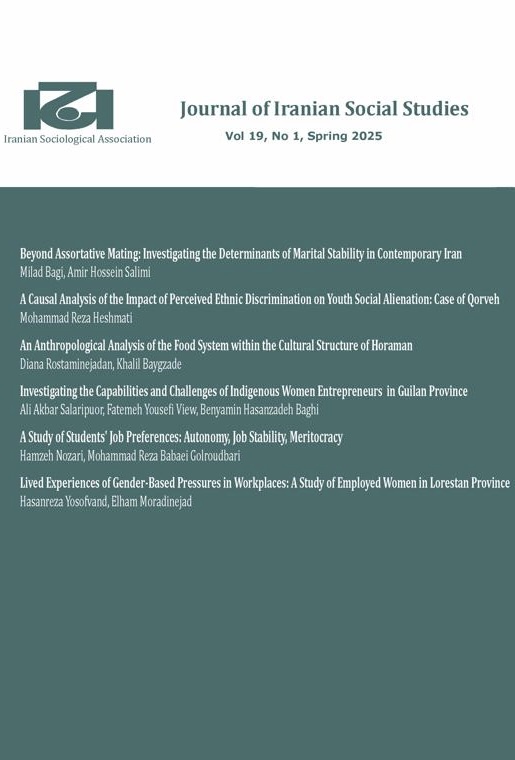
A Causal Analysis of the Impact of Perceived Ethnic Discrimination on Youth Social Alienation: Case of Qorveh

Pages 31-55

https://doi.org/10.22034/jss.2025.2066964.1911

Mohammad reza Heshmati

Abstract The present study aimed to analyze the impact of perceived ethnic discrimination on social alienation, with a particular focus on the mediating role of social exclusion among young people in the city of Qorveh. This applied research employed a quantitative approach and survey methodology. The statistical population consisted of all young individuals aged 18 to 30 residing in Qorveh, from which a sample of 384 participants was selected using stratified random sampling. Data were collected using a structured questionnaire incorporating standardized scales of ethnic discrimination, social exclusion, and social alienation. The reliability of the instruments was confirmed with Cronbach's alpha values ranging from 0.85 to 0.91, and their validity was supported through confirmatory factor analysis.
The results of structural equation modeling revealed that perceived ethnic discrimination had a direct and significant effect on social alienation, as well as a significant direct effect on social exclusion. Moreover, social exclusion had a stronger influence on social alienation and played a significant mediating role in transmitting the effect of perceived ethnic discrimination. The final model explained 52.3% of the variance in social alienation.
The findings confirm the proposed conceptual model and underscore the crucial role of social exclusion in amplifying the negative consequences of perceived ethnic discrimination. They highlight the urgent need to pursue cultural, educational, and social interventions and policies aimed at reducing discrimination and exclusion in multiethnic societies.

An Anthropological Analysis of the Food System within the Cultural Structure of Horaman

Pages 57-76

https://doi.org/10.22034/jss.2025.2055772.1891

Diana Rostami Nejadan, Khalil Baygzade

Abstract The food system, cooking and food consumption methods, in addition to biological needs, are based on kinship, cultural and social relations, national and religious, mythological and aesthetic beliefs; Therefore, the cultural structure of the food system, its beliefs and rituals, has a dual nature based on the functions of cultural structure and social relations which appears as dualities like: nature and culture, nomadic and sedentary, raw and cooked, man and woman, grain and oil, bread and meat. Food and eating system in Horaman region has a cultural, social, religious and religious role tailored on mythological and aesthetic identities in a dual system and opposite interaction. This article has investigated the characteristics and place of food in the cultural structure of Horaman region with the approach of anthropological structure based on qualitative study and field work, participatory observation, open interviews, library ethnographic method and the use of food anthropology resources in Horaman region. The results of the research show that food, in addition to physical needs, has a structure that is part of the cultural structures of Horaman region and has an anthropological application, As it has a constructive role in the rules, principles and values ​​governing the cultural system of Horaman region and it forms part of the national and religious beliefs and cultural and social values ​​and rituals of this region.

Investigating the Capabilities and Challenges of Indigenous Women Entrepreneurs in Guilan Province

Pages 77-102

https://doi.org/10.22034/jss.2025.2062617.1904

Aliakbar Salaripuor, Fatemeh Yousefiview, Benyamin Hasanzadeh baghi

Abstract The role of women entrepreneurs has become a key driver of economic and social transformation. Indigenous women entrepreneurs in Gilan, active in sectors such as handicrafts, tourism, and services, significantly contribute to local development. This qualitative study examined the challenges they face and their role in economic and social progress, considering their individual characteristics. Twenty-eight experienced women were purposively selected, and were interviewed by semi-structured in-depth methods. Through Analyzing the data, following Graneheim and Lundman method three main themes appeared: key constraints in business development, women’s role in social and economic transformation, and their capabilities and success strategies. Findings indicate that success arises from the interplay of institutional and financial limitations, social and familial support, and individual capacities. Accordingly, resilience, managerial skills, and social networks enable women to overcome barriers and build sustainable, impactful businesses. Thus, women’s entrepreneurship functions not only as an economic activity but also as a catalyst for broader social, cultural, and economic change.

A Study of Students' Job Preferences: Autonomy, Job Stability, Meritocracy

Pages 103-128

https://doi.org/10.22034/jss.2025.2066178.1910

Hamzeh Nozari, Mohammadreza Babaei Golroudbari

Abstract This study aimed to examine university students’ understanding and perceptions of employment in the public, private, and self-employment sectors. Using a qualitative approach, semi-structured interviews were conducted with 22 undergraduate and graduate students at Kharazmi University. Participants were selected through purposive sampling, and data collection continued until theoretical saturation was reached. The data were analyzed using thematic analysis at three levels: initial, secondary, and main themes. The findings indicate that students’ job preferences are shaped by factors such as economic independence, job stability, advancement opportunities, and competitive work environments. Most students preferred self-employment as a desirable and ideal career option, viewing it as a pathway to autonomy, self-actualization, and freedom of action. In contrast, some students opted for public sector employment due to its stability, welfare benefits, and structured environment. Employment in the private sector was also considered attractive by some students because of its meritocratic system and broader opportunities for personal and professional growth.

Lived Experiences of Gender-Based Pressures in Workplaces: A Study of Employed Women in Lorestan Province

Pages 129-155

https://doi.org/10.22034/jss.2025.2065134.1908

Hasanreza Yosofvand, Elham Moradinejad

Abstract The purpose of the present study is to explore the lived experiences of employed women in a government office in Lorestan Province when confronting sexual harassment and gender-based pressures. This study employed a descriptive phenomenological approach and Colaizzi's method of analysis. Data were gathered through 12 in-depth semi-structured interviews with employed women. The analysis of the data uncovered five main themes: sexual harassment as a continuous threat, compulsory silence as a protective shield, reconstruction of self-image in the face of harassment, the impact of patriarchal organizational culture, and social isolation as a consequence of harassment. The findings indicate that sexual harassment, influenced by power inequalities and cultural taboos, disrupts women's psychological and professional security, resulting in silence and isolation. This research underscores the need for establishing supportive mechanisms, anti-harassment training programs, and organizational structural reforms to mitigate sexual harassment.

To choose the oocyte donation as a way of becoming a mother (Phenomenological study of infertile women’s in Royan Institute)

Volume 8, Issue 1, Winter 2014, Pages 6-21

Nasrin Eyzadyar, Shirin Ahmadnia, Seyed Mohammad Seyedmirzaei, Seyed Ali Azin, Mohammad Yazdani Safa

Abstract Oocyte donation forms a part of so called "Assisted Reproduction Technology" (ART) that assists infertile women with ovarian problems or other medical factors to achieve their dream of having a child. Understanding the experience of infertile women in a difficult decision-making period for oocyte donation and selecting it over other alternatives (adoption or to live without children) is significant. Little is known about the lived experience of recipient women though, especially in Iran, due to the cultural, social, and religious conditions of the society. The present article describes the experience of those infertile women. This study was conducted using qualitative method and phenomenological approach with the aim of recognizing and describing the experiences of the women recipients of donated oocyte. Eleven participants were selected by purposive sampling method from women who had turned to Royan Infertility Institute in Tehran, Iran. The data were generated from transcription of taped Semi-structured in-depth interviews. Data analysis was in accordance with the procedure introduced by Colaizzi. Six main themes emerged from the women’s descriptions of their experiences:(1) the possibility of maintaining the confidentiality in egg donation; (2) the opportunity of having the experience of pregnancy, childbirth, and breastfeeding ;(3) the chance of genetic transition from husband ;(4) the impact of time factor in choosing oocyte donation ;(5) oocyte donation being permissible from a religious point of view; and (6) emotional and social burden of infertility.

Investigating Social Factors Affecting the Social and Political Participation (18 and Above Years Old Citizens of Karaj)

Volume 9, Issue 2, Summer 2015, Pages 64-87

B. Zare, M. Rohandeh

Abstract Social and political participation as essential feature of modernism is very important in modern societies. So participation (in all form of it including political, social, economic and cultural) is one of the main concepts of sociology and political science. The present study is a quantitative one which aims at examining the social factors affecting socio-political participation. The survey was conducted with a sample of 400 residents of Karaj in 2012. Data was collected through self-constructed questionnaire. The data were analyzed using multivariate liner regression, T. test, multiple regression and path analysis. Results of multiple regression analysis show that among independent variables the political satisfaction (beta = 0.33), the newspaper reading (beta = 0.25), the religiosity (beta = 0.19), and watching satellite (beta = 0.15), have significant effects on participation rate. Totally, independent variables of this study explain 0.41 of the variation of sociopolitical participation. In general, the results of study support the theoretical framework the study was based on.

Social security and social health (Case study of youth in Ghaen city)

Volume 9, Issue 1, Winter 2015, Pages 71-102

Golam Reza Khushfar, Arezo Mohammadi, Fatemeh Mohammadzadeh, Razieh Mohammadi, Fatemeh Akbarzade

Abstract The concept of social health, along with other aspects of health (physical, mental, spiritual), is a significant component and is influenced by many factors. Security, particularly social security is one of the most important factors related to social health.. Due to this importance, this study aimed at identifying the relationship between social security and social health of youth (15-29) years in Ghaen. The study relies on social health theory of Keyes and modern approach to social security.  ترجمه از: فارسیThe study is a survey with sample size of 376 which were randomly selected. Findings from the analyses of the data indicate significant and direct relationship between social security and social health. In addition, relationship between social security and social integration, acceptance, participation and social prosperity is positive and significant. Social acceptance has the highest and social integration has the lowest correlation with social security. At the same time, there is no significant relationship between social security and social cohesion.

Study of effective factors on social responsibility between students of Shahid Bahonar University of Kerman

Volume 8, Issue 2, Summer 2014, Pages 128-152

Leyla Yazdanpanah, Fatemeh Hekmat

Abstract This article examines effective factors on social responsibility which are necessary actions or personal reactions in different situations .Theories of mutual humanism, Bandora’s social learning and social roles theory are used. We conducted a survey and used a questionnaire to collect the data. The questioner was distributed among 404 male and female students of Shahid Bahonar University of Kerman in the year 2011, who are selected by random systematic sampling. The results show that the sense of self esteem, responsive and intimate parenting, formal and informal social participation, interpersonal social trust ,generalized institutional trust, gender and socio-economic position are effective variables on the youths’ social responsibility.

Mixed-Methods Research The Third Movement in the Methodology of Social Sciences

Volume 5, Issue 2, Summer 2012, Pages 158-181

Mohsen Niazi

Abstract Combined research methods are called the third movement in research methodology. It means that in conducting the social research, seeking combined research methods is needed for improving the methodology of research that started with qualitative and quantitative approaches. In conducting humanistic and social research, the main approaches have developed in different methodological directions. What is known as the first wave of methodological change, initiated the application of empiricism and quantification. After a period of exerting dominance, it was recognized that quantification was not successful in showing individuals’ thoughts and ideas on complex as well as specific issues and events. The second wave of methodology known as qualitative research developed in 1970-1980. It emphasized perception processes that led to consequences of issues under study. In the last decade, limitations of qualitative approaches in generalizing results, combination of research results with researcher specific values, and the problem of validity and reliability of data have been considered as important challenges in qualitative researches. Thus, it is important to consider combined approach as the third movement of methodology. The main purpose of combined method known as multi-characteristic approach is to combine qualitative and quantitative approaches for giving a more inclusive perception of research issues. In this approach limitations of each of qualitative and quantitative researches are compensated. In addition, this method offers more reliable evidence and proof for research that will help the researcher to answer the questions that are unanswered by each of the qualitative and quantitative approaches alone. The other purpose of this research is to study qualitative and quantitative methodology comparatively, in a manner so that to recognize methodological limitations of each of these two approaches and to offer combined methods as a basic type of approach in the humanities and social research.

Publication Information
Indexing and Abstracting

Keywords Cloud

Related Journals